
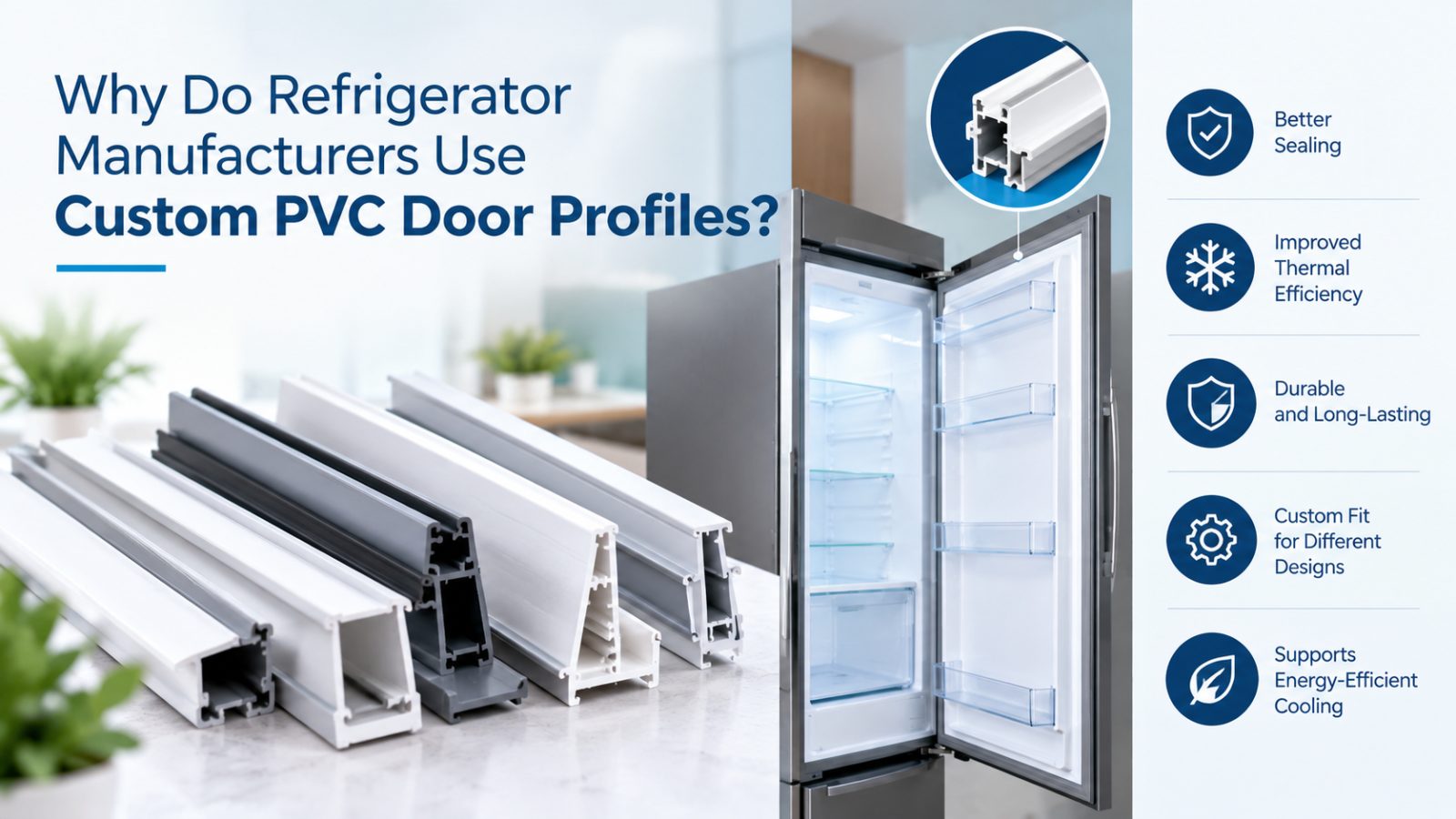
Refrigerator manufacturers use custom PVC door profiles to meet specific design, fitting, sealing and appearance requirements. These profiles are designed around the structure of the refrigerator door and the needs of the finished product. Working with a manufacturer that produces custom plastic profiles for refrigerator manufacturers can help businesses source components that match their drawings, dimensions and production requirements.
The right profile depends on the refrigerator design, the way its door is assembled and the material properties required for the application. Understanding these factors helps OEMs, refrigeration equipment manufacturers and procurement teams make informed decisions when sourcing PVC profiles.
What Role Do PVC Door Profiles Play in Refrigerator Manufacturing?
PVC door profiles are shaped plastic components used in refrigerator door assemblies and related applications. Their exact function depends on the product design and how the profile fits with other parts.
Manufacturers may require profiles to provide a defined edge, cover a joint, hold a component in position or meet a particular design requirement.
Custom profiles are useful when standard shapes do not match the dimensions or assembly needs of a refrigerator model. By developing a profile around the intended application, manufacturers can specify the shape and measurements required for their product.
Why Do Refrigerator Manufacturers Choose Custom PVC Door Profiles?
Refrigerator manufacturers work with different door designs, dimensions and assembly methods. Custom PVC extrusion allows profiles to be produced according to the requirements of a particular product.
1. Profiles Can Match Specific Door Designs
Different refrigerator models may require different profile shapes and dimensions. A standard profile may not fit every design, particularly when the door assembly has a specific cross-section or connection point.
Custom PVC door profiles can be designed using customer drawings and specifications. This allows the manufacturer to assess the required shape, dimensions and fit before production.
Refrigerator manufacturers work with different door designs, dimensions and assembly methods. Custom PVC extrusion allows profiles to be produced according to the requirements of a particular product. Understanding the role of refrigeration profiles for cooling equipment can also help manufacturers assess profile requirements for different cooling applications.
2. They Support Accurate Fitting and Assembly
The dimensions of a profile affect how it fits with other refrigerator components. Incorrect measurements may create gaps, fitting problems or assembly delays.
A custom profile can be developed around the required measurements and tolerances. Manufacturers should agree on the critical dimensions before production and check samples against the approved specifications.
Accurate fitting is especially important when the profile forms part of a larger door assembly.
3. Material Properties Can Be Matched to the Application
PVC is used in many profile applications because its properties can be suited to different product requirements through material selection and formulation.
When selecting PVC profiles for refrigerators, manufacturers should consider the intended function, required rigidity or flexibility, surface finish and operating conditions.
The correct material depends on the specific design. Buyers should discuss their requirements with the extrusion manufacturer rather than assuming that one PVC formulation suits every refrigerator application.
4. Custom Shapes Can Meet Different Manufacturing Requirements
Refrigerator manufacturers may need profiles with particular channels, grooves, edges or other cross-sectional features. These features depend on the way the profile is fitted and used.
Custom plastic extrusion allows the profile shape to be designed around the intended application, subject to tooling and manufacturing feasibility.
Providing a clear drawing helps the manufacturer assess the design and identify any details that need clarification before production.
5. They Support Consistency Across Bulk Orders
Manufacturers producing refrigerators in volume need components that match the agreed specifications across production runs.
A defined profile drawing, approved sample and clear quality requirements give both the buyer and manufacturer a reference for production.
For repeat orders, businesses should confirm that the same approved specifications will be used and agree on how any proposed changes will be reviewed.
How Are Custom PVC Refrigerator Door Profiles Developed?
Developing a custom profile involves several steps. Early communication between the buyer and manufacturer helps clarify the design and production requirements.
Step 1. Share the Technical Drawing
The buyer provides a cross-sectional drawing with the required dimensions, tolerances and other relevant details. Information about the refrigerator door assembly also helps explain how the profile will be used.
If a drawing is not available, the buyer should discuss what reference measurements or samples can be supplied.
Step 2. Confirm Material and Design Requirements
The manufacturer reviews the intended application, material requirements, profile shape and finish. Any unclear dimensions or manufacturing concerns should be discussed before production proceeds.
The buyer and manufacturer should also confirm the required order quantity and any specific quality criteria.
Step 3. Assess Tooling Requirements
The cross-sectional design determines the tooling needed for extrusion. The manufacturer assesses whether the proposed shape can be produced using the intended process.
Any design changes that affect the profile shape should be agreed upon before the tooling and production plan are finalised.
Step 4. Review Samples Before Bulk Production
Samples allow the buyer to check the profile’s dimensions, appearance and fit with the intended assembly.
If the sample does not meet the agreed requirements, the parties can discuss necessary changes before approving bulk production.
Step 5. Confirm Specifications and Production Schedule
Before placing the bulk order, confirm the approved drawing, material, quantity, packaging, quality checks and delivery schedule.
A clear specification helps reduce misunderstandings and gives the manufacturer a consistent reference for production.
What Should Buyers Check When Sourcing PVC Profiles for Refrigerators?
Choosing a supplier involves more than finding a manufacturer that can produce the required shape. Buyers should check whether the supplier can meet the technical, quality and commercial needs of the project.
Consider these points before placing an order:
- Customisation capability. Can the manufacturer assess your drawings and required dimensions?
- Material suitability. Can the material requirements be reviewed against the intended application?
- Sample availability. Can you inspect a sample before approving bulk production?
- Quality checks. Can the manufacturer check the profile against agreed dimensions and specifications?
- Production schedule. Are tooling, sample approval and production lead times clearly explained?
- Bulk supply. Can the supplier discuss your order quantity and repeat production requirements?
- Shipping arrangements. Can the manufacturer support the delivery destination and agreed shipping method?
Buyers should request a quotation based on the same drawings, material requirements and quantities when comparing suppliers. This makes it easier to assess the full offer rather than comparing unit prices alone.
How M3 Extrusion Supports Refrigerator Door Profile Requirements
M3 Extrusion is an Indian manufacturer of customised plastic extrusion profiles for industrial and commercial applications. With more than 13 years of manufacturing experience, the company supports B2B customers requiring custom profiles, OEM manufacturing and bulk production.
For refrigerator manufacturers, the company produces refrigerator door PVC profiles according to customer drawings, dimensions, material requirements and production specifications.
M3 Extrusion provides samples before bulk production and conducts ROHS testing. SGS test reports are available when applicable, and customer-appointed pre-shipment inspections are supported.
The standard production lead time is approximately 45 days after order confirmation, depending on the design and order quantity. Air freight is available for urgent orders, and the company supports long-term supply contracts.
Frequently Asked Questions
1. Why are custom PVC profiles used in refrigerator doors?
Custom PVC profiles can match specific door dimensions, cross-sectional shapes, fitting requirements and appearance needs. Their design depends on the refrigerator model and the role of the profile in the assembly.
2. Can refrigerator door PVC profiles be made to customer drawings?
Custom extrusion manufacturers can assess profiles based on customer drawings and specifications. The final design depends on dimensions, material requirements, tooling and manufacturing feasibility.
3. How do manufacturers select PVC material for refrigerator profiles?
They consider the profile’s function, required rigidity or flexibility, surface finish and operating conditions. The material should be assessed against the actual product requirements.
4. Why should buyers approve samples before bulk production?
Samples allow buyers to check dimensions, shape, finish and fit before approving a large order. This helps identify potential issues before full production begins.
5. What information is needed to request a quotation for refrigerator door profiles?
Provide a technical drawing, dimensions, material requirements, colour, expected quantity, application details and delivery destination. The manufacturer can use this information to assess the project and prepare a relevant quotation.
6. Can custom PVC refrigerator door profiles be supplied for repeat orders?
Repeat production can be discussed with the manufacturer. Buyers should agree on the approved drawing, material specification, quality criteria and expected ordering schedule to support consistency across future orders.
Summary
Custom PVC refrigerator door profiles help manufacturers meet specific design, fitting, material and production requirements. Their shape and dimensions should be based on the refrigerator’s design, while material selection and quality checks should reflect the intended application.
Before placing a bulk order, buyers should review technical drawings, approve samples, confirm production lead times and agree on quality standards.
If your business needs custom PVC profiles for refrigerator doors or related industrial applications, contact M3 Extrusion to discuss your drawings, specifications and bulk production requirements.