Ford’s 2021 Super Duty owner’s manual is specific about what a diesel particulate filter needs: speeds, durations, even engine rpm. That makes the failure mode easy to see. A truck whose days consist of idling, hopping between job sites or crawling through traffic can slide from a routine “cleaning exhaust filter” message to a filter the computer will no longer try to clean. Whether the fix turns out to be a highway drive, a parked regeneration, a diagnostic visit or Ford DPF cleaning in Delaware depends on how far the filter has gone and what filled it.
What Ford Says Regeneration Needs
The manual describes two automatic methods. In passive regeneration, normal exhaust temperature and chemistry oxidize the soot with no help. In active regeneration, once the filter is full, the engine control module raises exhaust temperature to burn the soot off.
Ford says regeneration works best at a constant speed above 30 mph with steady engine speed for about 20 minutes. For most driving, it says regeneration occurs every 100 to 500 miles and lasts 9 to 35 minutes. Owners may notice a changed exhaust tone, a hot metallic smell or a clicking sound at low speed, which the manual calls normal. It also warns against running out of fuel.
One caveat applies throughout. Ford’s online manual notes that it may describe content that operates differently on a particular vehicle. Super Duty messages and procedures have changed across model years, and Ford’s other diesels have their own documentation. Treat this article as a framework and your own truck’s manual as the authority.
The Duty Cycles That Work Against It
The manual names three kinds of use that call for extra effort: only short distances, frequently switching the ignition off, and a high level of acceleration and deceleration. Its remedy is an occasional drive of at least 20 minutes at higher speeds on a main road or freeway. Along the way, avoid prolonged idling, don’t switch the ignition off, and ideally hold engine speed between 1,500 and 3,000 rpm.
The operator-commanded regeneration section is blunter about duty cycle. It describes significant stationary operation, low-speed driving under 25 mph, drive times of less than 10 to 15 minutes, or a vehicle that never fully warms up. In those conditions, it says, passive and active regeneration may not sufficiently clean the filter. Many work trucks fit that description by Tuesday afternoon, and so do plenty of pickups that only make errands.
The pattern matters more than any single trip. A regeneration that gets interrupted by a shutdown doesn’t finish, and a truck that is parked mid-cycle week after week keeps adding soot to a filter that never fully clears.
The Parked Option and Its Limits
Operator-commanded regeneration lets the driver start the process at idle. Ford says it lasts roughly 30 minutes, depending on soot load, ambient temperature and altitude. The manual warns against parking over dry leaves, dry grass or other combustible material, and against standing near the tailpipe. Exhaust heat during regeneration is a real fire hazard.
It isn’t a universal fix. A 2011 U.S. Forest Service technical note on diesel aftertreatment says parked regeneration wasn’t available on pre-2011 Ford models. Its F-450/F-550 procedure also says the operator-commanded cycle can’t run while the “service engine soon” light is on. In other words, a truck that refuses a parked regeneration may be reporting a separate fault that has to be found first.
For a broader look at how forced regeneration compares with cleaning, see this forced regeneration guide.
What Happens at the Threshold
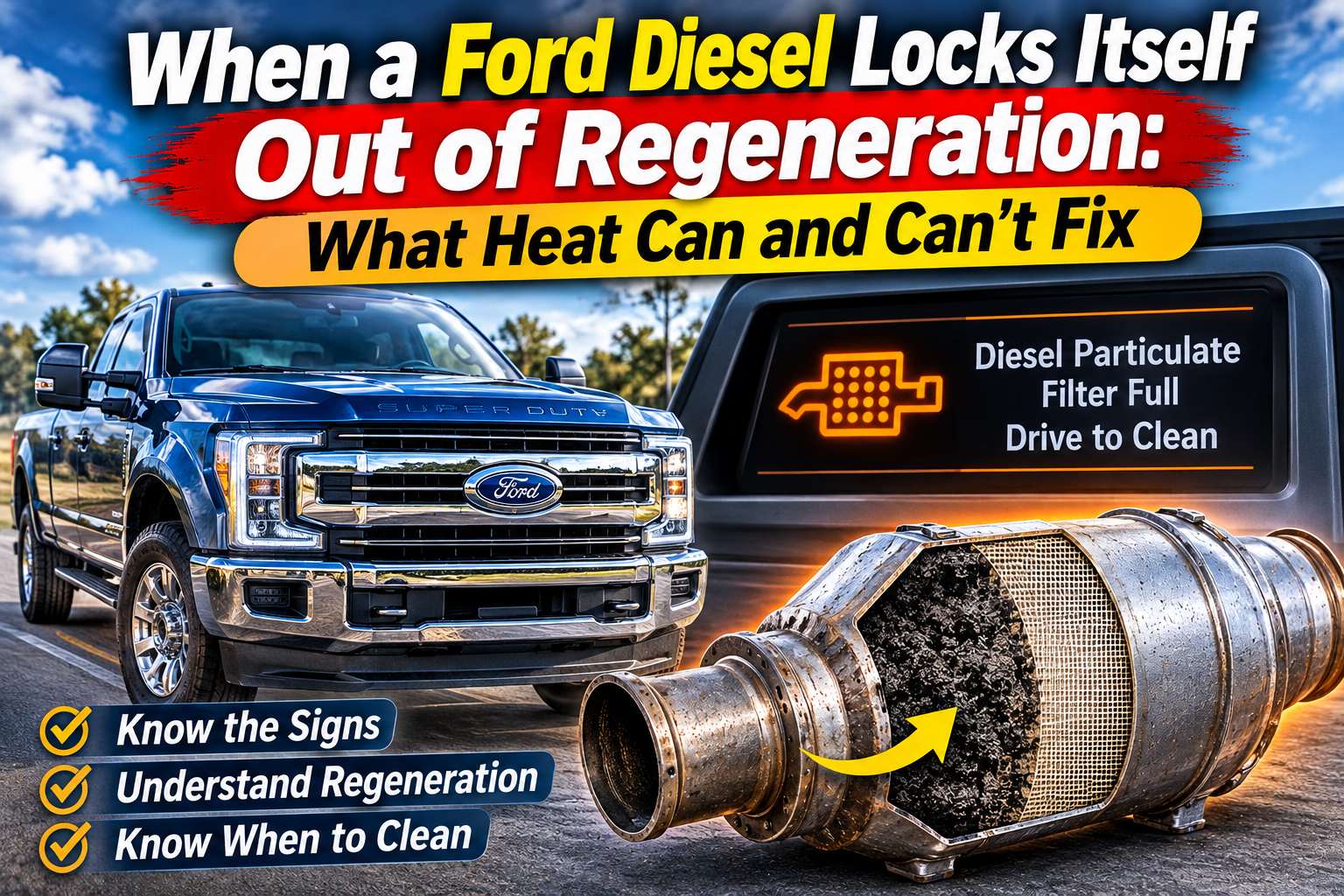
The manual says that if the filter fills beyond the regeneration threshold, the vehicle disables both active and operator-commanded regeneration. That can lead to irreversible damage requiring replacement, which may not be covered by the warranty. It also says to follow information messages, since ignoring them may degrade performance and could cause engine damage.
The Forest Service table for the 2011 6.7L F-450/F-550 shows the escalation. First comes “Drive to Clean Exhaust Filter,” which calls for driving above 30 mph or a parked regeneration, about 20 minutes either way. Next is “Reduced Engine Power” with a derate imminent. Finally the engine is derated and service is required. Wording varies by model year, but the lesson holds. The message is the cheap moment to act, and each stage after it narrows the options.
Soot, Ash and the Limits of Heat
Four situations get lumped together, and they call for different responses.
A temporary regeneration issue is an interrupted cycle: the truck wants a longer run than it has been getting. A drive or a parked regeneration usually resolves it.
Soot accumulation is the same problem further along. Heat can still burn soot, but only while the truck is permitted to try. Past the threshold described above, that permission is gone and the repair moves to a shop.
Ash buildup is a different category. Soot burns. Ash, the residue left behind, doesn’t. The California Air Resources Board’s DPF handbook, written with heavy-duty engines in mind, states that ash removal is separate from regeneration and that the filter periodically has to be removed and cleaned. No amount of highway driving changes that.
The fourth situation is a filter whose cleaning problem is upstream. As a general diesel-maintenance principle, not a Ford-specific rule, an engine that produces excess soot, or sends oil into the exhaust, can refill a cleaned filter quickly. Faulty sensors can also make regeneration run poorly or not at all. Cleaning treats the filter and nothing else, which is why diagnosis comes first.
Where Professional Cleaning Fits
Cleaning becomes a reasonable consideration when the evidence points at the filter itself. Examples include a regeneration that completes but is followed by the same messages soon after, a filter the truck has locked out, or one that stays restricted after a documented clean regeneration. The question to answer beforehand is whether something upstream explains the loading.
Removal and cleaning gives a shop access to ash and deposits that heat can’t address. Methods and verification differ between shops. Some, like 30 Minute DPF Clean in New Jersey, which services Power Stroke and Super Duty filters, test airflow before and after, so you have a measurement rather than a promise. Cleaning has limits. Filters that are cracked, melted or heavily contaminated may not be recoverable, so inspection comes before any assurance.
Before approving work, collect the details a good shop will ask about: the message your truck displayed, the exhaust-filter percentage if your display shows it, whether you tried a parked regeneration and what happened, any stored codes or active service engine soon light, and a plain account of your typical week of driving. Those facts separate a truck that needs a longer drive from one that needs a filter off the exhaust.