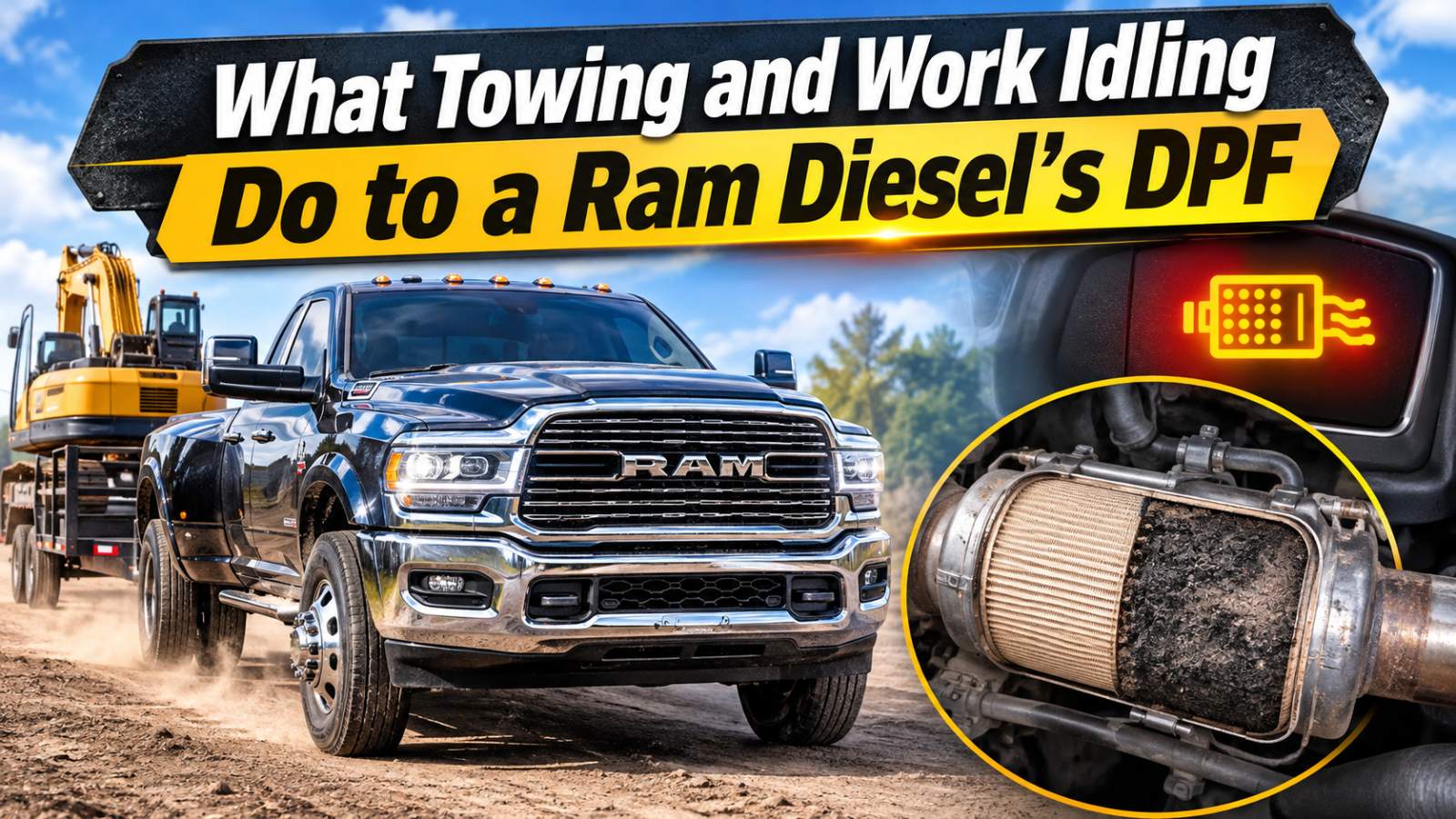
A Ram 3500 spends the week idling at a job site with the heater on, hauls a loaded trailer for forty minutes on Friday, and shows an exhaust filter message on Monday. The owner’s first guess is the load. A shop’s first guess is a cleaning. Ram DPF cleaning in new jersey is sometimes the right answer. But “heavy use clogs the filter” is too simple, and the correct fix depends on what the truck’s own data shows.
What the filter does on a Ram diesel
On Ram’s Cummins-powered heavy-duty pickups, and on diesels like the EcoDiesel in the 1500, the particulate filter traps soot from the exhaust. Ram’s owner literature describes the system as self-cleaning. The engine control module manages combustion and exhaust temperature so trapped soot burns off in a regeneration, usually with no input from the driver. Exhaust in the filter gets very hot during that process. One Ram manual puts it at around 1,100°F, so it’s worth thinking about where you park. Details differ by engine, model year, and emissions configuration.
What Ram says moves the needle
Ram’s manual for 2018 diesel pickups lists what affects how often regeneration happens: extended idling, towing, short trips, fuel quality, city driving, aftermarket grilles, oversized tires, and gear ratios. Towing is on that list as a variable. It isn’t treated as a villain or a cure.
Here’s why. A loaded engine makes more soot, and it also makes more exhaust heat. On a long, steady highway pull, that heat can be enough for regeneration to keep up. On a short loaded haul followed by a stop, you get the soot without the recovery. Work idling sits at the other end. The engine runs, the filter collects, and the exhaust stays cool. Two trucks can both count as “heavy use” and have completely different filters.
None of that means towing automatically clears a filter. The pattern of use decides whether regeneration gets finished.
What the dash is telling you
Ram’s owner’s manual for 2022 2500 and 3500 trucks describes a sequence of messages. A “filter full” message asking you to drive at highway speeds appears when the filter reaches 80 percent of its capacity. The manual adds that under exclusively short, low-speed driving, the system may never reach the conditions needed to remove the trapped soot. A “regeneration in process” message means the truck is working on it, and the advice is to keep driving conditions steady. A “service required, see dealer” message means regeneration has been disabled because of a system malfunction, which is a different situation entirely.
The manual also ties regeneration to maintenance. Ignoring the oil change indicator and resetting it at zero miles remaining can prevent the filter from running its cleaning routine. Messages and thresholds vary by model year, so go by the manual for your truck.
Soot burns. Ash doesn’t
Soot is carbon, and regeneration handles it. Ash is the non-combustible residue of burned oil and its additives. It stays in the filter, and no regeneration removes it. A hard-working truck can collect both, but only soot responds to regen.
When a Ram keeps requesting regens soon after a completed one, ash or something upstream is on the table. And if a filter keeps loading after a professional cleaning, usage habits often explain it. There’s a good rundown on recurring DPF blockages on Rams and the habits behind them.
When it isn’t the workload
A frequent-regeneration code isn’t proof of a dirty filter or a hard-working truck. In October 2024, FCA issued a technical service bulletin for 2022–2023 Ram 2500 and 3500 pickups with the 6.7-liter Cummins, built within a specific window. It covers trucks that set code P2459, diesel particulate filter regeneration too frequent, and that may enter derate. The cause listed is a manufacturing issue, and the repair is a warranty filter replacement, performed only when the code is set and related faults have been addressed first.
That’s one narrow case tied to certain build dates. It shows why frequent regeneration deserves diagnosis, plus a look at bulletins and warranty coverage for your VIN, before anyone books a cleaning or buys a filter. Other causes are more common: sensors and their lines, exhaust leaks, fueling or air-system problems, and oil consumption.
Matching the fix to the filter
Regeneration fits soot, when the truck can complete it. Cleaning fits an intact filter holding ash or hardened soot that regeneration can’t clear, once diagnosis rules out leaks, sensors, and whatever is feeding the filter. Replacement fits a cracked or melted substrate, a filter that fails testing, or a case a bulletin covers.
A provider such as 30 Minute DPF Clean lists Ram 2500/3500 6.7 Cummins and EcoDiesel filters among those it services. With any shop, ask for inspection notes and before-and-after flow numbers.
Keep a log
Workload sets the pattern, and the pattern plus the truck’s data makes the decision. Note when messages appear, what the truck had been doing, and whether a sustained drive cleared them. A few weeks of notes will show whether you’re dealing with usage, ash, or something that needs a technician.